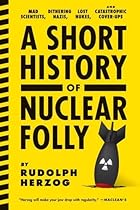
A Short History of Nuclear Folly
| Author | : | |
| Rating | : | 4.26 (568 Votes) |
| Asin | : | 1612193307 |
| Format Type | : | paperback |
| Number of Pages | : | 256 Pages |
| Publish Date | : | 2017-12-11 |
| Language | : | English |

DESCRIPTION:
A revolutionary way of extracting uranium 235 from natural uranium in the 1940s made it possible, decades later, for pretty much any country—including some you would really, really not want to have this ability—to build a nuclear bomb. Nuclear testing in Nevada in the early 1950s rendered an area of neighboring Utah highly radioactive, causing widespread cancer in the inhabitants of a small town, including, collaterally (and perhaps apocryphally), some temporary residents—the cast and crew of one of the worst movies ever made, The Conqueror (with John Wayne, who would later die of cancer, as Genghis Khan). It’s a story, in large part, about unintended consequences. --David Pitt . Alternately funny and scary but overall mostly scary, the book reminds us just how frightening the Cold War really was. Military surveillance satellites, powered by small atomic power plants, were put into orbit in the 1960s;
Rudolph Herzog is the author of Dead Funny: Humor in Hitler’s Germany. His documentary on humor in the Third Reich, Laughing with Hitler, scored top audience ratings on German Channel 1 and was also broadcast on the BBC. Jefferson Chase is one of the foremost translators of German history. A documentary by Rudolph Herzog based on A Short History of Nuclear Folly will be r
He explores the “accidental” drop of a Nagasaki-type bomb on a train conductor’s home, the implanting of plutonium into patients’ hearts, and the invention of wild tactical nukes, including weapons designed to kill enemy astronauts.Told in a riveting narrative voice, Herzog—the son of filmmaker Werner Herzog—also draws on childhood memories of the final period of the Cold War in Germany, the country once seen as the nuclear battleground for NATO and the Warsaw Pact countries, and discusses evidence that Nazi scientists knew how to make atomic weaponry and chose not to.From the Hardcover edition.. In the spirit of Dr. From the rarely-discussed nightmare of “Broken Arrows” (40 nuclear weapons lost during the Cold War) to “Operation Plowshare” (a proposal to use nuclear bombs for large engineering projects, such as a the construction of a second Panama Canal using 300 H-Bombs), Herzog focuses in on long-forgotten nuclear projects that nearly led to disaster.In an unprec
Good premise, but contains errors and omissions For the average reader, it does offer a 'short' history, but it makes a few errors and omissions that damages the rest of the work.The most glaring is the brief reference of the Bikini Atom Tests taking place in 19Good premise, but contains errors and omissions Merrimack Jack For the average reader, it does offer a 'short' history, but it makes a few errors and omissions that damages the rest of the work.The most glaring is the brief reference of the Bikini Atom Tests taking place in 1948 (it was 1946) a battleship being mislabeled as a destroyer, along with typos that may be due to the translation of the book. Some events, such as the SL-1 Reactor accident in Idaho are completely absent from the work, and attention is cast on the USS Scorpion, a nuclear sub lost off the coast of Africa, yet the USS Thresher, a nuclear sub lost off Cape Cod is not mentioned at all.The firs. 8 (it was 19Good premise, but contains errors and omissions Merrimack Jack For the average reader, it does offer a 'short' history, but it makes a few errors and omissions that damages the rest of the work.The most glaring is the brief reference of the Bikini Atom Tests taking place in 1948 (it was 1946) a battleship being mislabeled as a destroyer, along with typos that may be due to the translation of the book. Some events, such as the SL-1 Reactor accident in Idaho are completely absent from the work, and attention is cast on the USS Scorpion, a nuclear sub lost off the coast of Africa, yet the USS Thresher, a nuclear sub lost off Cape Cod is not mentioned at all.The firs. 6) a battleship being mislabeled as a destroyer, along with typos that may be due to the translation of the book. Some events, such as the SL-1 Reactor accident in Idaho are completely absent from the work, and attention is cast on the USS Scorpion, a nuclear sub lost off the coast of Africa, yet the USS Thresher, a nuclear sub lost off Cape Cod is not mentioned at all.The firs. George Poirier said Perils of the Nuclear Age – A Snapshot. I thoroughly enjoyed this fascinating book. Based on today’s knowledge about nuclear fallout and the biological effects of ionizing radiation, some of the strange things that were thought up by otherwise brilliant and influential people are beyond belief. This short book – “A Short History” – just gives an overview of what was ultimately revealed to have happened; there are probably many more “nuclear follies” that continue to remain secret. Although I consider myself well-read in the area of nuclear science/technology development/history, there was much infor. "Basically correct, but" according to Mike M. poorly written. The author did a good job in researching, but the finished product strikes me as amateurishly written and a tad clumsy. I share an interest in the history of nuclear weapons and can find little problems in the factual issues of the book, but the author interjects too much personal opinion, it would be better to let the reader draw their own conclusions.